

How Qnetic Is Rethinking the Energy Storage Market
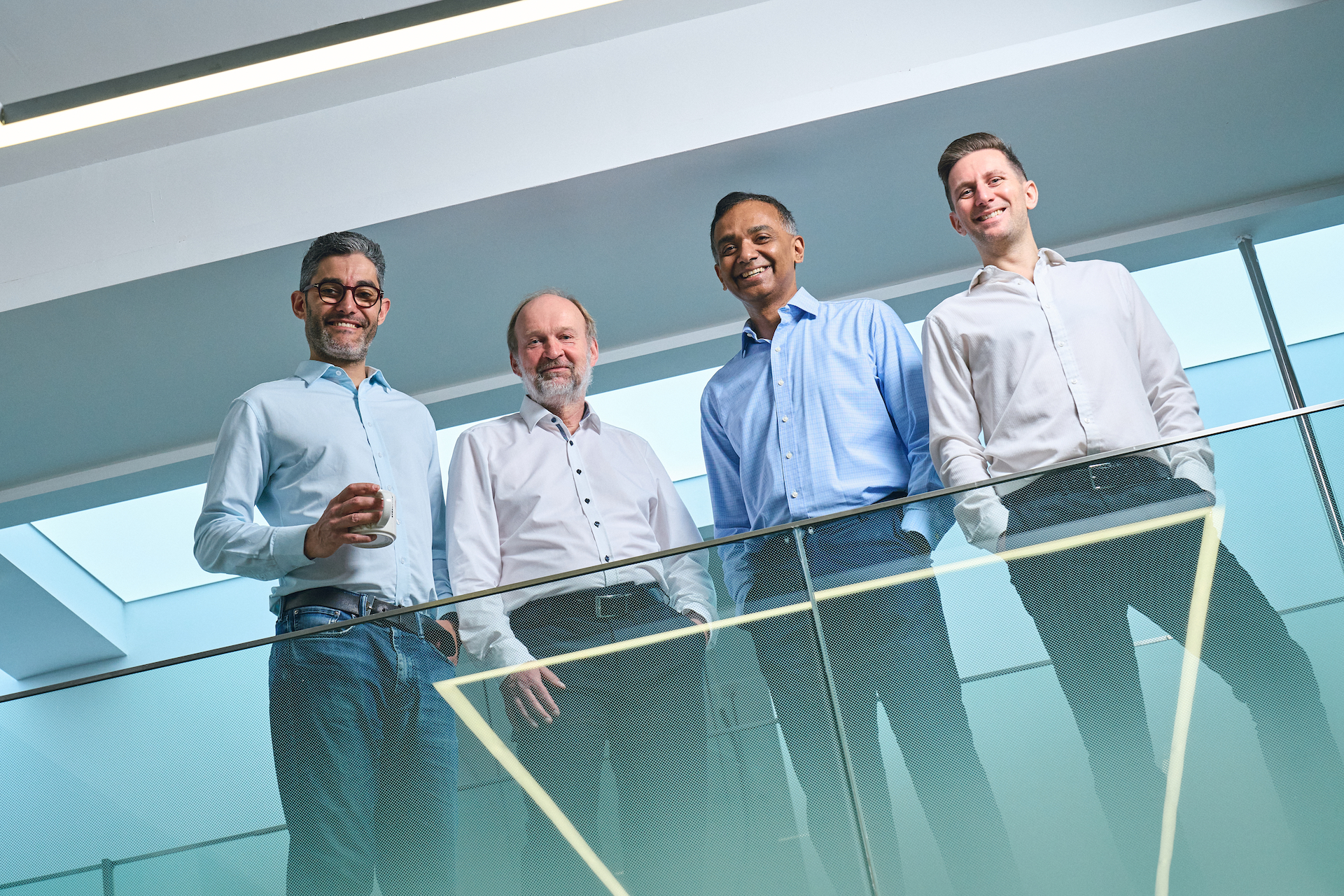
Qnetic Management Team: Loïc Bastard, Mathias Mier, Malcolm Mathews, Michael Pratt
Qnetic setzt auf mechanische Energiespeicher statt Lithium-Ionen – mit Fokus auf Langlebigkeit, Wirtschaftlichkeit und geringere geopolitische Abhängigkeiten.
NEW YORK, NY, UNITED STATES, August 6, 2026 /EINPresswire.com/ -- While billions flow into lithium-ion batteries, Qnetic is pursuing a different approach: mechanical energy storage. CEO Michael Pratt explains why he doesn't intend to win the competition on lower upfront costs, but on higher returns, longer service life, and geopolitical independence."Nobody is going to beat lithium-ion on price alone." That the line comes from Michael Pratt seems surprising at first. After all, the co-founder and CEO of Qnetic is working on exactly that — challenging the dominant storage technology on the electric grid. For Pratt, though, there's no contradiction. Anyone who judges energy storage solely by its purchase price, he argues, is asking the wrong question. What matters isn't the sticker price but the economic value a storage system can create over decades.
Qnetic aims to deliver on that claim with a technology fundamentally different from conventional batteries. At its core is a kinetic battery — a roughly 20-foot-tall cylinder housing a carbon-fiber rotor that spins at nearly three times the speed of sound. Magnetically levitated, held in a vacuum, and virtually silent, the system stores energy not electrochemically but as pure motion. With it, Qnetic is taking on lithium-ion batteries, which are widely considered efficient and keep getting cheaper. However, battery cells age with every charging cycle, they pose considerable risks in the event of a fire, and their supply chains, by common estimates, are roughly 95 percent shaped by Chinese manufacturers.
The bet rests on a simple principle. "Everything is ultimately energy. Everything you look at is an embodiment of energy in some form," Pratt says. For him and his co-founder Loïc Bastard, an engineer with experience building jet and wind turbines, that led to a diagnosis that still drives the company today: climate change, at its core, is not a generation problem but a storage problem. The two worked out much of the idea from a distance — while Bastard quit his job and spent three months cycling 3,700 miles, Pratt set up the company in Shanghai. "We took a very long time horizon and asked ourselves one question," he recalls. "When we're old men looking back — what did we do?"
"This wasn't a problem of energy generation, it was a problem of energy storage." — Michael Pratt, CEO, Qnetic
That the answer would turn out to be a flywheel of all things was hardly foreseeable at the outset. "I just said to Loïc: what about flywheel energy storage? And he said: ‘I don't think that works.’" But the idea stayed with Bastard. He started running the numbers, sketching — and initial skepticism turned into a company. When Bastard finished his bike trip, Pratt traveled out to meet him at the finish. From that idea, the two began working together on developing a new type of energy storage.
A battery that spins
To understand what came of it, it helps to look inside. What Qnetic builds, Pratt calls a "kinetic battery." From the outside, it behaves like any other storage system. You charge it with electricity, you discharge it again. The difference lies in the principle. "Unlike ordinary batteries, which store energy as a kind of electrochemical potential, we store the energy purely mechanically — in the form of kinetic energy." A motor accelerates a rotor; the faster it spins, the more energy it holds. To discharge, the process runs in reverse: the momentum drives a generator and sends the power back out.
The real trick is keeping that stored momentum with almost no losses. "We suspend the rotor entirely magnetically. It sits on a magnetic cushion in three-dimensional space, and inside the chamber there's a vacuum." Friction is so low, he says, that a fully charged system keeps spinning for about 20 days. Behind the calm exterior, things are anything but placid. The rotor's rim speed, according to Pratt, is around Mach 3. "From the outside it's almost silent, and you'd never guess there's this high-energy object spinning inside." The first product, the Q500, stands about 20 feet tall.
The grid's monoculture
As simple as the physics is, the market Qnetic is pushing into is just as one-sided. "It's a very monolithic playing field," Pratt says. "There's basically one big technology everyone has settled on — lithium-ion batteries." Its best-known incarnation is Tesla's Megapack. Efficient, proven, falling in price — and yet burdened with structural weaknesses that Pratt sorts into two categories: technical and geopolitical.
On the technical side, he points first to degradation and short cycle life. "Everyone knows this from their phone. The first two years it works beautifully, then the battery starts to die." With grid storage it's worse, he says, because the system is fully charged and discharged every day; after 10 to 15 years the entire installation has to be replaced. Then there's fire risk: "If there's an incident, the fire department can't do anything. They have to watch it burn." In parts of New York State, Pratt reports, battery installations have been banned in individual jurisdictions.
The second and larger lever is provenance. "Lithium-ion batteries are effectively a Chinese-controlled technology," Pratt says. "Probably 95 percent of all cells come from China — and even for cells made in, say, the U.S., the components or the materials are Chinese." For grid operators, he argues, that's a security risk: "If China wanted to cut off supply, it could." The argument is more politically charged in 2026 than ever. The U.S. Department of Defense has placed trade restrictions on prominent Chinese storage companies such as CATL and BYD beginning in 2027, and both the U.S. and the EU have placed restrictions on Chinese-made storage inverters.
"You don't have to compete with China. You can take Qnetic." — Michael Pratt
The obvious way out — Europe and the U.S. building their own cell factories — has proven expensive. "There are companies that have spent many billions on gigafactories in Europe and the U.S., and lost billions and gone bankrupt in the process," Pratt says. Rather than catching up with China on cell chemistry, Qnetic wants to change the field. Its own materials are commodity stuff: carbon fiber (produced in Japan, the U.S., and Europe), steel, aluminum, copper, plus magnets. There is a China dependency for neodymium magnets, he concedes, but the quantities used are small.
Value, not cost
Geopolitics alone, though, doesn't sell a single storage unit. The stronger argument is economic — and it turns on the word Pratt makes the core of his pitch: value. Because the rotor doesn't degrade, it can be charged and discharged as many times per day as you like, and that is exactly what an operator's revenue hangs on. "Lithium-ion operators are effectively limited to one cycle a day," Pratt explains. That's not a law of nature but a consequence of warranty terms. Run more than the agreed roughly 365 cycles a year and you void the warranty. "That one cycle per day is the revenue ceiling. With Qnetic there is no such ceiling. You're limited only by the number of hours in the day." Two or three cycles a day would mean double or triple the return.
Over a system's lifetime, that adds up to a cost advantage the industry measures as the "levelized cost of storage" (LCOS) — the all-in cost of a stored kilowatt-hour across the full service life. A widely cited study Qnetic produced in 2024 with energy economists Oliver Schmidt and Iain Staffell of Imperial College London put the advantage at 38 percent — projected to 2030, Qnetic would come in at about $101 per megawatt-hour versus $164 for lithium-ion. These days Pratt runs more aggressive numbers: "We're at about half the levelized cost of storage of lithium-ion batteries." The upfront price, he says, is comparable to lithium-ion; the advantage only emerges in operation. As Pratt puts it: "It's not just about cost. It's about value."
A sports car becomes a semi truck
That Qnetic can capture that value at all is due to a deliberate break with everything that came before. Flywheels are not a Qnetic invention — quite the opposite. Until now they have served as short-duration backup power, in telecommunications for instance: high output, for a few seconds or minutes, low capacity and a high price. "That's not what the grid needs," Pratt says. "The grid needs very high energy capacity, long discharge duration, and we want to make it cheap." His image for it: "Most historical flywheel storage is like a sports car — high performance, fast, limited utility. What we're designing is more like a semi truck, with enormous storage capacity, built for long distances."
What makes that leap possible is above all the rotor. Where competitors use solid steel rotors, Qnetic uses carbon-fiber composite. "To reach an energy capacity similar to our first product, you'd need hundreds of tons of steel. We achieve it with about five or six tons of carbon fiber." The fiber orientation is optimized for maximum strength, the wall thin and hollow. The company has now filed four patents — two on the architecture of the bearing system, one on the rotor, one on the suspension bearing. The target metric everything is aligned to is what Pratt calls his "North Star": dollars per kilowatt-hour.
The moat nobody planned
Some competitive advantages only emerge in the building — as at Qnetic. To certify its storage system, the company has to test it, and in a way that keeps any potential failure case containable. "Our system is 20 feet tall and contains an enormous amount of stored energy. We couldn't find a lab that could test it for us," Pratt says. So the company built its own test cell for around $1 million. "That's probably unique worldwide." An unplanned necessity thus became a technical moat, comparable to a jet engine manufacturer's test stand.
The grid — and the hungry data centers
That leaves the question of who is supposed to buy all this. Pratt has two applications in mind. The first is storage farms on the edges of cities and communities, supplying entire regions. The second is the reason so much capital is currently flowing into the sector: AI data centers. "Their power demand swings by hundreds of megawatts within milliseconds or seconds," Pratt says. That's hard for the grid to absorb, which is why data centers need buffers — today usually lithium-ion. "Qnetic can go from zero to any number of megawatts, with no degradation and no thermal issues." For this segment, the company even declared its own category in June 2026: "AI-grade energy storage." The need is enormous, after all; data center power consumption is likely to double by 2028, according to Pratt — a demand surge the grid "hasn't seen in decades."
"There's a long tail behind AI. The bottleneck, in the end, is energy." — Michael Pratt
From Funding to Market Adoption
Qnetic is seeking to support its further growth through additional equity financing via the U.S. Regulation Crowdfunding (Reg CF) framework rather than relying exclusively on traditional venture capital. According to the company, it completed a Reg CF financing round in March 2026 and has raised additional capital through previous funding rounds. Qnetic states that it intends to continue strengthening its capital base through further financing activities. The company also reports that early participants in its crowdfunding rounds have seen an increase in the value of their holdings following the conversion of their investment instruments into equity.
On the demand side, Qnetic can already point to letters of intent totaling more than $110 million. Among the interested parties is Arevon, the largest Tesla Megapack customer. CEO Pratt tempers inflated expectations, however. Binding orders are only expected to follow the pilot projects planned for early 2027. Those will be accompanied by independent testing institutions, whose test reports play a central role for potential customers.
Qnetic has since made public collaborations with the Electric Power Research Institute (EPRI) and the National Lab of the Rockies (formerly NREL). Even after a successful pilot phase, the CEO expects long lead times. From order to commissioning, he says, typically takes at least one and often two years. His message to investors stays correspondingly sober: "We're in hard tech. The energy sector is conservative and slow. I'm not going to build castles in the air here."
The vision — and the open questions
Where all of this is meant to lead, Pratt frames in an image: "Our vision is a Qnetic energy storage system on the edge of every city and every community." Decarbonization has to be thought about regionally, he argues — not "How do we decarbonize steel?" but "How do you decarbonize a city?" Production is slated to start in Sacramento, later possibly in Malaysia and Saudi Arabia. Backing comes from venture investor SOSV and, according to industry reports, an unnamed Saudi investor. Alongside its New York headquarters, Qnetic maintains sites in Shanghai, Singapore, and Germany, where Qnetic GmbH operates under General Manager Mathias Mier; as early as 2023, the company tested prototypes at the Janneby community wind farm in northern Germany.
For all the excitement, a conservative outlook remains warranted. Qnetic is a hardware company still under construction. The Q500 alpha prototype is only now being built, and the first systems will initially run throttled at 100 to 200 kilowatt-hours instead of 500. The $110 million in letters of intent are legally non-binding, the decisive field tests are still ahead — and the competition isn't standing still. Alongside established alternatives such as flow batteries and pumped hydro, other companies are also working on grid-capable flywheels. And financing via crowd investing at a self-set valuation of $45 million may generate publicity, but it is subject to less external price discipline than a classic venture round.
Pratt himself would hardly disagree — his candor about time horizons is persuasive. "We need to be sufficiently funded to get through this phase, and we can't assume we'll be profitable right after a pilot. We need investors who are in it for the longer term." Whether 20-foot spinning rotors on the edge of every city become reality will ultimately be decided not in the narrative but on the test stand. "If we can prove our technology and back up our claims," Pratt says, "we have a market and we have customers who like it and want it."
Qnetic at a glance
Founded by CEO Michael Pratt and CTO Loïc Bastard, Qnetic is developing the Q500, a solid-state flywheel energy storage system designed for long service life and grid-scale applications. According to the company, it completed a Reg CF financing round in March 2026 and intends to further expand its capital base. Qnetic also reports signed Letters of Intent exceeding US$110 million, including with Arevon, while venture investor SOSV is among its backers.
Michael Pratt
Qnetic Energy Storage Inc.
media@qnetic.energy
Visit us on social media:
LinkedIn
Instagram
Facebook
YouTube
X
How Qnetic Works
Legal Disclaimer:
EIN Presswire provides this news content "as is" without warranty of any kind. We do not accept any responsibility or liability for the accuracy, content, images, videos, licenses, completeness, legality, or reliability of the information contained in this article. If you have any complaints or copyright issues related to this article, kindly contact the author above.
